Research
Design philosophy and research foundations behind DetectX verification systems.
Research Philosophy
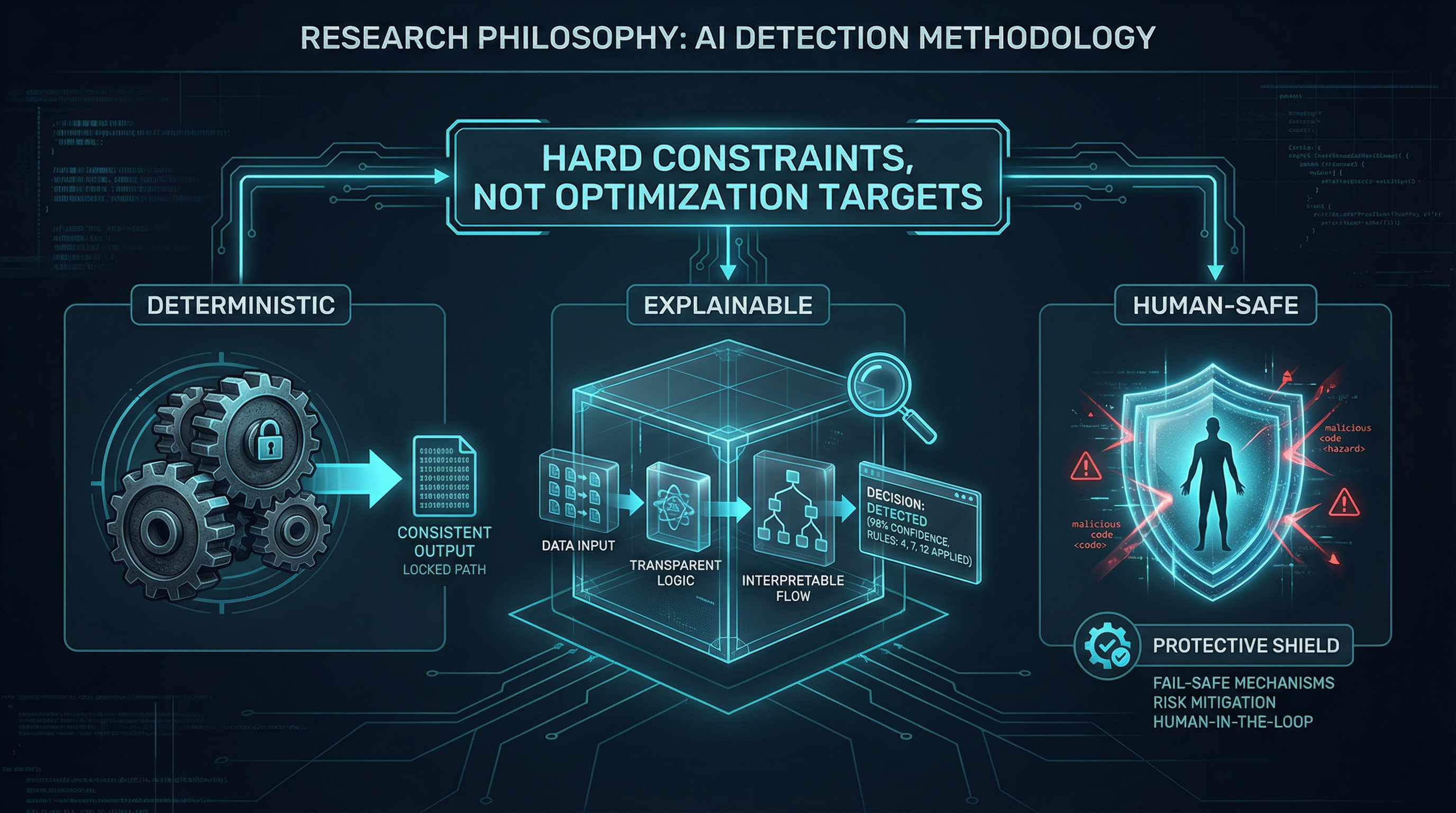
DetectX is built on the principle that evidence-based verification must be deterministic, explainable, and human-safe. These are not optimization targets—they are hard constraints that shape every design decision.
The research program prioritizes reliability over sensitivity. A system that occasionally misclassifies human work as AI-generated causes more harm than a system that occasionally fails to detect AI content. Human safety is non-negotiable.
Why Probability-Based Detection Fails
Most AI detection systems output probability scores: "87% likely AI-generated." These scores create several fundamental problems:
- •Threshold ambiguity: What does 87% mean? Is 60% enough to act on? Different users apply different thresholds, leading to inconsistent outcomes.
- •False precision: Probability scores imply a level of certainty that the underlying models cannot support. The number feels authoritative but is often arbitrary.
- •Reproducibility failures: Many probabilistic systems produce different scores on repeated analysis of the same content, undermining evidence-based credibility.
- •Human harm: When human-created work receives a high AI probability score, the creator faces an impossible burden of proof. The score becomes an accusation without recourse.
DetectX rejects probability-based outputs entirely. The system reports structural observations, not statistical inferences.
Human-Normalized Baselines
The foundation of DetectX verification is the human-normalized baseline: a reference model constructed exclusively from verified human-created content.
Baselines are constructed from verified human-created content spanning diverse genres, languages, production styles, and recording conditions. The calibration process prioritizes minimizing false positive risk above all other metrics.
Content that falls within baseline parameters is reported as showing no AI signal evidence. Baseline updates follow strict versioning and validation procedures.

Multi-Stage Verification Approach
DetectX uses a proprietary multi-stage architecture that prioritizes human protection while maintaining effective AI detection. The specific engine design is protected under pending patent applications.
DetectX Audio
AI-generated music detection with 98.89% human protection accuracy. Multiple independent analysis stages cross-validate to minimize false positives.
DetectX Voice
Deepfake voice detection with 97.8% accuracy. Optimized for telephony conditions including G.711 codec and background noise. 2-second minimum for detection.
Both products share the same research philosophy: human safety as a hard constraint, deterministic analysis, and binary verdict outputs. Each uses proprietary detection technology developed in-house.
Determinism as a Forensic Requirement
Forensic systems must be deterministic. The same input must always produce the same output. This is not a preference—it is a requirement for any system whose results may inform consequential decisions.
DetectX achieves determinism through:
- •Versioned models and baseline references
- •Reproducible analysis workflows that can be independently verified
- •Binary verdict outputs without probabilistic ambiguity
Failure Cases and Corrections
No verification system is perfect. DetectX acknowledges known limitations and maintains documented correction procedures:
- •Edge cases: Unusual production techniques may produce signal geometry outside baseline parameters. These cases are documented and baselines are updated accordingly.
- •Hybrid content: Content that combines human and AI elements may produce ambiguous results. The system reports what it observes without inferring intent.
- •Format artifacts: Extreme compression or format conversion may introduce signal artifacts. Minimum quality thresholds are enforced.
When errors are identified, baseline parameters are reviewed and updated through documented versioning procedures. All corrections are logged and traceable.
What DetectX Refuses to Do
Certain capabilities are intentionally excluded from the DetectX system:
- •Authorship determination: DetectX does not identify who created content. It reports structural observations only.
- •Model attribution: DetectX does not identify which AI system generated content. It detects structural anomalies, not model signatures.
- •Intent inference: DetectX does not infer creative intent, deception, or purpose. It reports signal geometry.
- •Legal conclusions: DetectX does not provide legal opinions or certifications. Results are technical observations for professional interpretation.
Ongoing Research Areas
Active research programs include:
- •Voice deepfake detection across telephony conditions and languages
- •Baseline expansion for additional audio genres and production contexts
- •Robustness testing against adversarial manipulation
- •Verification systems for image, text, and video content
New modalities will be introduced only after they meet the same evidence-based reliability and human-safety standards as DetectX Audio and DetectX Voice.
DetectX exists to provide a evidence-based reference that can be trusted. The research program is guided by a single principle: verification systems must protect human creators, not endanger them.