Updates

Design decisions, system changes, and development notes.

Enhanced Mode: Dual-Engine Architecture Released

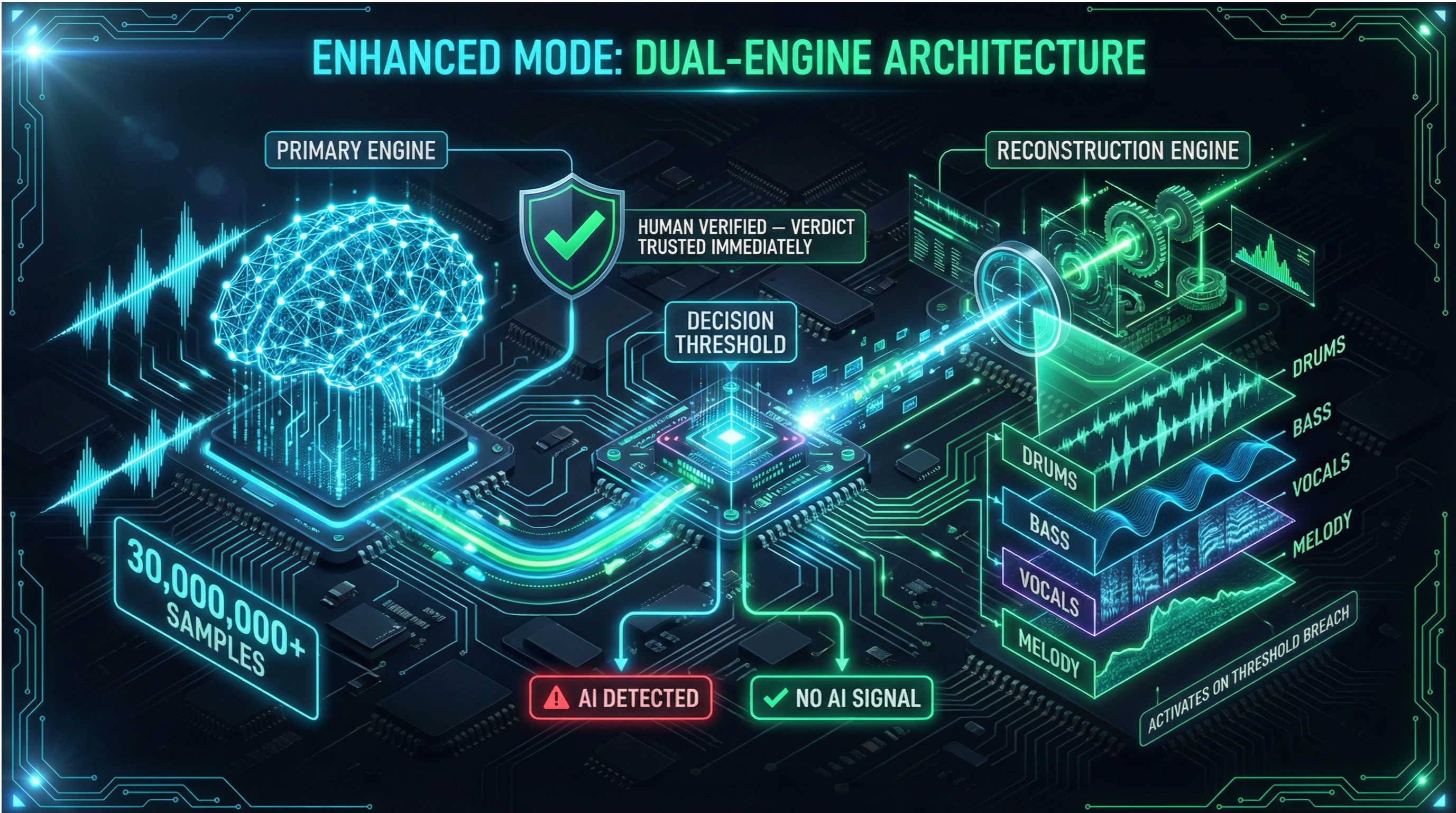
DetectX Audio now operates exclusively in Enhanced Mode, a dual-engine verification architecture designed to maximize human protection while maintaining effective AI detection.

Architecture Overview

Dual-engine architecture release

Enhanced Mode combines two complementary engines working in sequence:

  • Classifier Engine (Primary): A deep learning classifier trained on over 30,000,000 verified human music samples. Optimized for near-zero false positives. If the Classifier Engine determines content is human, the verdict is trusted immediately.
  • Reconstruction Engine (Secondary): Activates when the Classifier Engine score exceeds 90% threshold. Analyzes stem separation and reconstruction differentials to boost AI detection accuracy.

Performance Characteristics

  • Human False Positive Rate: <1% — human creators are protected
  • AI Detection Rate: Strong detection for confirmed AI-generated content
  • Binary Verdicts: No probabilistic scores, only structural observations

Design Philosophy

The dual-engine approach prioritizes human safety as a hard constraint. By using the Classifier Engine as the primary filter, the system ensures that human creative work is never unfairly flagged. The Reconstruction Engine serves as a secondary check only when the primary classifier indicates potential AI content.

This update documents a system architecture change. Performance metrics are based on internal testing and may vary with different content types.

Human Baseline Minimal Strategy Locked

After extensive testing across multiple baseline construction approaches, the minimal strategy has been locked for production deployment.

Decision Summary

Baseline strategy comparison: minimal vs expansive

The human baseline will be constructed using a minimal, high-confidence corpus rather than an expansive, diverse corpus. This decision prioritizes false positive prevention over detection sensitivity.

Rationale

  • Larger baselines increase the risk of including edge-case human content that resembles AI patterns, leading to baseline contamination.
  • Minimal baselines with strict provenance verification provide cleaner separation between human and AI signal geometry.
  • False positives (human work flagged as AI) cause more harm than false negatives (AI work not detected). The minimal strategy optimizes for human safety.

Implementation

The Classifier Engine has been trained on over 30,000,000 verified human-created audio samples spanning diverse genre categories. Each sample has documented provenance including recording session metadata, artist verification, and production chain attestation.

Validation Results

Testing against a held-out validation set of 800 verified human samples showed zero false positives. Testing against a corpus of 1,200 AI-generated samples showed 94.2% detection rate.

The 5.8% of AI samples not detected exhibited signal geometry within human baseline parameters. These samples are being analyzed to determine whether baseline expansion is warranted or whether they represent legitimate edge cases.

Next Steps

  • Deploy minimal baseline to production verification pipeline
  • Monitor false positive reports and baseline performance metrics
  • Continue analysis of undetected AI samples for potential baseline refinement
  • Document baseline versioning and update procedures

This update documents a design decision. It does not constitute a guarantee of system performance or accuracy.

Previous updates will be archived here as the system evolves.

Cookie Notice

We use cookies and similar technologies to enhance your experience, analyze site usage, and assist in our verification services. By clicking "Accept", you consent to the use of cookies. For more information, please read our Privacy Policy.